
Thursday, August 30, 2007


Monday, August 06, 2007
Strange Dream
I t was yesterday .
A strange dream , I'll post it in few points , but firstly i want to mention that it's a symbolism.
-Drunk friend by my wine bottle , faced a battery.
-A young girl fights to see a police major.
-Underground road event full of strange shape of drunk ppl and me inside it with noway out.
Comments .... ?
A strange dream , I'll post it in few points , but firstly i want to mention that it's a symbolism.
-Drunk friend by my wine bottle , faced a battery.
-A young girl fights to see a police major.
-Underground road event full of strange shape of drunk ppl and me inside it with noway out.
Comments .... ?
Wednesday, August 01, 2007
Vista Vs Linux
Something that always will never end :
Comparing Vista <> Linux ,
Some points and factors that i would like to log it , maybe it's a type of reference for 1D10T Microsoftians
Guy quotes => /*... */
me => Bold
/*
OK, let me ask you a simple question about Linux shell:
Can you explore object models in linux shell? (i.e. SQL Server, Oracle, etc)? So you can go to any object and type dir and you'll get all the relations, functions, properties, variables, etc?
*/
-Oracle doesn't use .net in linux so that's silly question
-There already is a object-based shell try to google "object+shell" Linux.
Personally, I'd map those things onto fs-level objects, fs-named.
/*
And about viruses, please don't ever mix viruses with vulnerabilities, if a virus is working on your system due to a vulnerability, then it's a security issue, otherwise it's not related to security at all, it's just another program!
*/
You should realize looking at that list that it's mostly third party software
1)There are TONS of applications available for linux that are all free. A lot are on this list
2) Security in open source projects tends to be more proactive and open- so more vulnerabilities are reported , at the time windows is a closed source and facing always vulnerabilities even at the system level.
3) if you want to compare the security as it relates to YOUR system, look at remotely exploitable vulnerabilities in the services you are running not a random list of programs from 2 years ago
/*
Enterprise Linux is not for free (its price is more than windows server)
i.e.:
The most expensive edition of Windows Server is Windows Server 2003 R2 Enterprise Edition, it costs $3,999 for 25 CALs, and it comes in 32bit and 64 bits.
While redhat Red Hat Application Stack premium costs $8,499
*/
The application stack is a marketing term and it's not more than a bunch of applications,
You have to know what you want to do before thinking in what you want to use.
You don't need "integrated applications and solutions", you need a system that does something.
And Linux provide a bunch of applications in different distros for this purpose and you can make your own application stack for free.
/*
1- When I referred to Oracle I was giving an example (by the way google is supporting .Net since version 10).
*/
Even if Oracle 10 is supporting .Net but not under Linux.
/*
2- I don't think that "vulnerabilities" in kernel fall under "3rd party tools"
*/
Kernel is always as i said an "open source project tends to be more proactive and open- so more vulnerabilities are reported" in a comparison to win kernel.
/*
3- Refer back to my last post about the term "free", nothing free in this world
*/
All the bunch of available open source softwares aren't free ?!! with an already applications integrations and inter managed dependencies all in one distro available for download and with available support from its communities from all over the world.
Comparing Vista <> Linux ,
Some points and factors that i would like to log it , maybe it's a type of reference for 1D10T Microsoftians
Guy quotes => /*... */
me => Bold
/*
OK, let me ask you a simple question about Linux shell:
Can you explore object models in linux shell? (i.e. SQL Server, Oracle, etc)? So you can go to any object and type dir and you'll get all the relations, functions, properties, variables, etc?
*/
-Oracle doesn't use .net in linux so that's silly question
-There already is a object-based shell try to google "object+shell" Linux.
Personally, I'd map those things onto fs-level objects, fs-named.
/*
And about viruses, please don't ever mix viruses with vulnerabilities, if a virus is working on your system due to a vulnerability, then it's a security issue, otherwise it's not related to security at all, it's just another program!
*/
You should realize looking at that list that it's mostly third party software
1)There are TONS of applications available for linux that are all free. A lot are on this list
2) Security in open source projects tends to be more proactive and open- so more vulnerabilities are reported , at the time windows is a closed source and facing always vulnerabilities even at the system level.
3) if you want to compare the security as it relates to YOUR system, look at remotely exploitable vulnerabilities in the services you are running not a random list of programs from 2 years ago
/*
Enterprise Linux is not for free (its price is more than windows server)
i.e.:
The most expensive edition of Windows Server is Windows Server 2003 R2 Enterprise Edition, it costs $3,999 for 25 CALs, and it comes in 32bit and 64 bits.
While redhat Red Hat Application Stack premium costs $8,499
*/
The application stack is a marketing term and it's not more than a bunch of applications,
You have to know what you want to do before thinking in what you want to use.
You don't need "integrated applications and solutions", you need a system that does something.
And Linux provide a bunch of applications in different distros for this purpose and you can make your own application stack for free.
/*
1- When I referred to Oracle I was giving an example (by the way google is supporting .Net since version 10).
*/
Even if Oracle 10 is supporting .Net but not under Linux.
/*
2- I don't think that "vulnerabilities" in kernel fall under "3rd party tools"
*/
Kernel is always as i said an "open source project tends to be more proactive and open- so more vulnerabilities are reported" in a comparison to win kernel.
/*
3- Refer back to my last post about the term "free", nothing free in this world
*/
All the bunch of available open source softwares aren't free ?!! with an already applications integrations and inter managed dependencies all in one distro available for download and with available support from its communities from all over the world.
SOME FACTS
-USer-mode((glibc=linux/unix style) || (win32=c runtime)) both refere to standard C style lib
-Win32 has huge dependecies on the NT kernel
-Win32 API the that manipulate the kernel vista
Linux vulnerabilities:
-Most linux vulnerabilities are found and fixed by the kernel developers before they are at all popular for exploits
-If we want to make a comparison, look at the TIME ( the time the exploit was in wild , with exploit code available and used, until the time a patch was released, sum that up for all remote exploits on both kernels ) that vulnerabilities had exploit code in the wild not the number of them.
-Also , we should consider whether we will be depending on the distro to manage our security updates , or get them directly from kernel source update, the former will increase the time an exploit is available .
-Number of _public_ vulnerabilities = number of vulnerabilities reported by people.
That has precious little to do with the number of vulnerabilities present and undiscovered
that said , linux is a changing target ; it gets more new code in than closed systems(or more slowly developing software in general).
-There are many reasons people normally know these reasons, and saying "foo X is more secure than Y, because it has less _public_ vulnerabilities" is pretty moot
Kernel comparison :
-Vista kernel can not be compared to linux one cause nt kernels do not provide unix semantics to programs
-The NT kernel doesn't natively support *any* devices except the serial port , which is used to dump memory when you get a BSOD ;)
-Windows drivers are supplied by the vendors.
-Apart from proprietary drivers, like ATI NVIDIA etc, the Linux kernel contains all the drivers, in windows , when you buy a new card/whatever the vendor supplies a driver the majority included with wondows are made by the vendor and certified by M$ (and the vendor got it from the guys who made the chip)
Linux shell / PowerShell :
As a test for shell performance,
-I'd toss in a command line like
"time for file in *.jpg;do convert "$file{file%.jpg}.png";done > convert.log"
measure time of the following for every file with extension .jpg, call the convert command with as first parameter the filename, as second parameter the filename with the trailing '.jpg' replaced with '.gif,' end of loop write all output generated by the loop to convert.log.
-I do not know how this would be done in PowerShell, but i expect it to be rather painful
-I assume any shell worth the name has some mechanism like pipes, but i doubt they would come close to the flexibility you have with line-based data and tools like tr, grep and sed
-Questions regarding Power shell :
Is there anything resembling ‘which’?
Is there anything like history expansions (!$, !*, !!)?
What about command substitution (ls -l `which ls`)?
What about background jobs ?
Object model :
-Personally, I'd map those things onto fs-level objects, fs-named.
-We would produce a text representation of the object, which would then be manipulated through the usual tools and converted back into an object by a program if it so desires , there is nothing preventing us from writing a program (which you could call from bash) which parses such expressions and does things accordingly , though command-line-interfaces to dbus work this way.
Finally what about the /Proc in Vista , is there something could be the same and with the exact possibilities ?
Vista or any Window$ is available for how many Archs ?
-Win32 has huge dependecies on the NT kernel
-Win32 API the that manipulate the kernel vista
Linux vulnerabilities:
-Most linux vulnerabilities are found and fixed by the kernel developers before they are at all popular for exploits
-If we want to make a comparison, look at the TIME ( the time the exploit was in wild , with exploit code available and used, until the time a patch was released, sum that up for all remote exploits on both kernels ) that vulnerabilities had exploit code in the wild not the number of them.
-Also , we should consider whether we will be depending on the distro to manage our security updates , or get them directly from kernel source update, the former will increase the time an exploit is available .
-Number of _public_ vulnerabilities = number of vulnerabilities reported by people.
That has precious little to do with the number of vulnerabilities present and undiscovered
that said , linux is a changing target ; it gets more new code in than closed systems(or more slowly developing software in general).
-There are many reasons people normally know these reasons, and saying "foo X is more secure than Y, because it has less _public_ vulnerabilities" is pretty moot
Kernel comparison :
-Vista kernel can not be compared to linux one cause nt kernels do not provide unix semantics to programs
-The NT kernel doesn't natively support *any* devices except the serial port , which is used to dump memory when you get a BSOD ;)
-Windows drivers are supplied by the vendors.
-Apart from proprietary drivers, like ATI NVIDIA etc, the Linux kernel contains all the drivers, in windows , when you buy a new card/whatever the vendor supplies a driver the majority included with wondows are made by the vendor and certified by M$ (and the vendor got it from the guys who made the chip)
Linux shell / PowerShell :
As a test for shell performance,
-I'd toss in a command line like
"time for file in *.jpg;do convert "$file{file%.jpg}.png";done > convert.log"
measure time of the following for every file with extension .jpg, call the convert command with as first parameter the filename, as second parameter the filename with the trailing '.jpg' replaced with '.gif,' end of loop write all output generated by the loop to convert.log.
-I do not know how this would be done in PowerShell, but i expect it to be rather painful
-I assume any shell worth the name has some mechanism like pipes, but i doubt they would come close to the flexibility you have with line-based data and tools like tr, grep and sed
-Questions regarding Power shell :
Is there anything resembling ‘which’?
Is there anything like history expansions (!$, !*, !!)?
What about command substitution (ls -l `which ls`)?
What about background jobs ?
Object model :
-Personally, I'd map those things onto fs-level objects, fs-named.
-We would produce a text representation of the object, which would then be manipulated through the usual tools and converted back into an object by a program if it so desires , there is nothing preventing us from writing a program (which you could call from bash) which parses such expressions and does things accordingly , though command-line-interfaces to dbus work this way.
Finally what about the /Proc in Vista , is there something could be the same and with the exact possibilities ?
Vista or any Window$ is available for how many Archs ?
Monday, January 22, 2007
CVS Reminder
-First Set the Env. Var. CVSROOT to the cvsrepo directory
-mk. dir. ( project ) wishing to add it to the repos. inside the repos.
-Checkout this directory
-Add files and commit.
-mk. dir. ( project ) wishing to add it to the repos. inside the repos.
-Checkout this directory
-Add files and commit.
Sunday, January 21, 2007
Google hacks security vulnerabilities
Default Resources:
Directory Listings :
return URLs that contain directory listings of /admin.
Directory Listings :
return URLs that contain directory listings of /admin.
more queries that take advantage of directory listings:
Error Messages:Remote Services:
GoogleAnalytics V.s AW
Google analytics as a __remote-hosting__ statistics analyzer tool;
useful features:
- Browser & Platform Combos versions
- Unique/returner Visitors
- Languages
- Referring Source Google, yahoo....
- Java Enabled
- Geo Location
- Geo Map Overlay
- Flash Version
- Connection Speed
- Network Location
- Top Content/Content by title.
- Depth/Length of Visit
- XML/excel/Tab-separated exportation for every single statistic.
What's in Aw. and not of Google A. :
-rush hours report
-Visits of robots checker
-Worms attacks checker
-Number of times your site is "added to favorites bookmarks".
-Whois links
-Static reports in one or framed HTML/XHTML pages, experimental PDF export.
Aw Requirements :
-Server must log web access in a log file you can read.
-Ability to run Perl scripts (.pl files) from command line and/or as CGI.
-Somehow Aw. can be used locally without server access by either SFTPing all logs but only if they are made accessible and work on them locally, or by using a _trick_ ,
Add a tag to call a CGI script like _pslogger_ into each of the web pages that acquiring analysis . This to have an artificial log file that can be analyzed by AW.
For dereferencing / presentation issues ;
useful features:
- Browser & Platform Combos versions
- Unique/returner Visitors
- Languages
- Referring Source Google, yahoo....
- Java Enabled
- Geo Location
- Geo Map Overlay
- Flash Version
- Connection Speed
- Network Location
- Top Content/Content by title.
- Depth/Length of Visit
- XML/excel/Tab-separated exportation for every single statistic.
What's in Aw. and not of Google A. :
-rush hours report
-Visits of robots checker
-Worms attacks checker
-Number of times your site is "added to favorites bookmarks".
-Whois links
-Static reports in one or framed HTML/XHTML pages, experimental PDF export.
Aw Requirements :
-Server must log web access in a log file you can read.
-Ability to run Perl scripts (.pl files) from command line and/or as CGI.
-Somehow Aw. can be used locally without server access by either SFTPing all logs but only if they are made accessible and work on them locally, or by using a _trick_ ,
Add a tag to call a CGI script like _pslogger_ into each of the web pages that acquiring analysis . This to have an artificial log file that can be analyzed by AW.
For dereferencing / presentation issues ;
Saturday, January 20, 2007
localhost.localdomain
A while back I was trying to set up some packaging tools on a Debian system, and came across a problem where my host was identifying itself as host/localhost.localdomain .
Firstly hostname returned the correct thing (i.e. servername), and secondly that /etc/hosts looked like this:
x.x.x.x servername.mydomain.com servername
127.0.0.1 localhost.localdomain localhost servername
some applications can’t cope with 127.0.0.1 returning localhost.localdomain instead of localhost.
Replacing that last line with
127.0.0.1 localhost localhost.localdomain servername
solved the problem - i.e. localhost.localdomain wants to be an alias,
this was using a sarge system; I don’t know what the current situation is with etch, nor whether it has been fixed in recent sarge update.
Firstly hostname returned the correct thing (i.e. servername), and secondly that /etc/hosts looked like this:
x.x.x.x servername.mydomain.com servername
127.0.0.1 localhost.localdomain localhost servername
some applications can’t cope with 127.0.0.1 returning localhost.localdomain instead of localhost.
Replacing that last line with
127.0.0.1 localhost localhost.localdomain servername
solved the problem - i.e. localhost.localdomain wants to be an alias,
this was using a sarge system; I don’t know what the current situation is with etch, nor whether it has been fixed in recent sarge update.
Linux Kernel - Intro
I see it important to give a bit of information regarding the Linux kernel , for whom don't know more than that Linux is power fulled cause of kernel without knowing anything more about it.
We can say that the __Kernel__ is the core of operating system;
it is the program that controls the basic services that are utilized by user programs.
The kernel is responsible for:
-CPU resource scheduling (regarding process management)
-Memory management (including protection implementation)
-Device control (providing the device-file/device-driver interface)
-Security (device, process and user level)
-Accounting services (including CPU usage and disk quotas)
-Inter Process Communication (shared memory, semaphores and message passing)
Kernel does the memory management for all of the running programs (processes) and that they all get a fair share of the processor’s cycles, also provide portable interface for programs to talk to hardware.
It is physically a file that is usually located in the /boot directory. Under Linux, this file is called vmlinuz.
Foo-bar:/home/mina# ls -l /boot/vm*
-rw-r--r-- 1 root root 1231478 Jan 24 2005 /boot/vmlinuz-2.6.8-2-686-smp
-The size of the kernel is Dependant on what features compiled into it, what modifications made to its data structures and what additions made to its code.
-vmlinuz is referred to as the kernel image. At a physical level, this file consists of a small section of machine code followed by a compressed block. At boot time, the program at the start of the kernel is loaded into memory at which point it uncompresses the rest of the kernel.
-/usr/src/linux is a soft link to /usr/src/ within this directory hierarchy are in excess of 1300 files and directories which consists of around 400 C source code files, 370 C header files, 40 Assembler source files and 46 Makefiles. These, when compiled, produce around 300 object files and libraries; large portion of this is driver code.
-Only drivers that are needed on the system are compiled into the kernel, the rest can be placed separately in things called modules.
-Kernel Boot steps:
1) The boot loader program (e.g. grub) starts by loading the vmlinuz from disk into memory, then starts the code executing.
2) After the kernel image is decompressed, the actual kernel is started. This part of the code was produced from assembler source.
Technically at this point the kernel is running. This is the first process (0) and is called swapper. Swapper does some low level checks on the processor, memory and FPU availability, then places the system into protected mode. Paging is enabled.
3) Interrupts are disabled though the interrupt table is set up for later use. The entire kernel is realigned in memory (post paging) and some of the basic memory management structures are created.
4) At this point, a function called start_kernel is called.
start_kernel is physically located in /usr/src/linux-2.x.x../init/main.c and is really the core kernel function.
5) start_kernel sets up the memory, interrupts and scheduling.
In effect, the kernel now has multi-tasking enabled.
The console already has several messages displayed to it.
6) The kernel command line options are parsed (those passed in by the boot loader) and all device driver modules are initialized.
7) Then memory initializations occur, socket/networking is started and bug checking.
8) The final action performed by swapper is the first process creation with fork whereby the init program is launched. Swapper now enters an infinite idle loop.
-The timer interrupts are now set so that the scheduler can step in and pre-empt the running process. However, sections of the kernel will be periodically executed by other processes.
Comment or give some detailed discussion if you do like.
We can say that the __Kernel__ is the core of operating system;
it is the program that controls the basic services that are utilized by user programs.
The kernel is responsible for:
-CPU resource scheduling (regarding process management)
-Memory management (including protection implementation)
-Device control (providing the device-file/device-driver interface)
-Security (device, process and user level)
-Accounting services (including CPU usage and disk quotas)
-Inter Process Communication (shared memory, semaphores and message passing)
Kernel does the memory management for all of the running programs (processes) and that they all get a fair share of the processor’s cycles, also provide portable interface for programs to talk to hardware.
It is physically a file that is usually located in the /boot directory. Under Linux, this file is called vmlinuz.
Foo-bar:/home/mina# ls -l /boot/vm*
-rw-r--r-- 1 root root 1231478 Jan 24 2005 /boot/vmlinuz-2.6.8-2-686-smp
-The size of the kernel is Dependant on what features compiled into it, what modifications made to its data structures and what additions made to its code.
-vmlinuz is referred to as the kernel image. At a physical level, this file consists of a small section of machine code followed by a compressed block. At boot time, the program at the start of the kernel is loaded into memory at which point it uncompresses the rest of the kernel.
-/usr/src/linux is a soft link to /usr/src/ within this directory hierarchy are in excess of 1300 files and directories which consists of around 400 C source code files, 370 C header files, 40 Assembler source files and 46 Makefiles. These, when compiled, produce around 300 object files and libraries; large portion of this is driver code.
-Only drivers that are needed on the system are compiled into the kernel, the rest can be placed separately in things called modules.
-Kernel Boot steps:
1) The boot loader program (e.g. grub) starts by loading the vmlinuz from disk into memory, then starts the code executing.
2) After the kernel image is decompressed, the actual kernel is started. This part of the code was produced from assembler source.
Technically at this point the kernel is running. This is the first process (0) and is called swapper. Swapper does some low level checks on the processor, memory and FPU availability, then places the system into protected mode. Paging is enabled.
3) Interrupts are disabled though the interrupt table is set up for later use. The entire kernel is realigned in memory (post paging) and some of the basic memory management structures are created.
4) At this point, a function called start_kernel is called.
start_kernel is physically located in /usr/src/linux-2.x.x../init/main.c and is really the core kernel function.
5) start_kernel sets up the memory, interrupts and scheduling.
In effect, the kernel now has multi-tasking enabled.
The console already has several messages displayed to it.
6) The kernel command line options are parsed (those passed in by the boot loader) and all device driver modules are initialized.
7) Then memory initializations occur, socket/networking is started and bug checking.
8) The final action performed by swapper is the first process creation with fork whereby the init program is launched. Swapper now enters an infinite idle loop.
-The timer interrupts are now set so that the scheduler can step in and pre-empt the running process. However, sections of the kernel will be periodically executed by other processes.
Comment or give some detailed discussion if you do like.
Friday, January 19, 2007
RELAX-NG V.s W3C XML-Schema | Jing
As of start packaging Jing, the _RELAX NG validator_ to Debian, i was going with some bit of difference analysis between the RELAX-NG and the W3C XML-Schema language.
For some more info regarding _Jing _ , it implements :
* RELAX NG 1.0 Specification,
* RELAX NG Compact Syntax, and
* parts of RELAX NG DTD Compatibility,
specifically checking of ID/IDREF/IDREFS.
Firstly analyzing the advantages of XML-Schema over the DTD,
XML-Schema over DTD
-It provides much greater specificity than DTDs could. some of these specificities are namespace aware, and provide support for types.
Then the features not supported by RELAX-NG,
XML-Schema over RELAX-NG..:
-RELAX NG lacks any analog to
-RELAX NG has slightly poorer specificity, i.e., it is not possible to define a specific number or range of repetitions of patterns.
-XML-Schema has a formal mechanism for attaching a schema to an XML document.
Then what is better regarding RELAX-NG in:
RELAX-NG Over XML-Schema
-It is the compact and has an equivalent form that is much more like a DTD, but with greater specifiability
-Also it provides very strong support for unordered content.
-RELAX-NG also allows for non-deterministic content models.
-RELAX NG allows attributes to be treated as elements in content models while W3C XML Schema cannot specify such a dependency between the content of an attribute and child elements.
-Most RELAX NG schemas can be algorithmically converted into W3C XML Schemas and even DTDs (except when using RELAX NG features not supported by those languages, as above)
For some more info regarding _Jing _ , it implements :
* RELAX NG 1.0 Specification,
* RELAX NG Compact Syntax, and
* parts of RELAX NG DTD Compatibility,
specifically checking of ID/IDREF/IDREFS.
Firstly analyzing the advantages of XML-Schema over the DTD,
XML-Schema over DTD
-It provides much greater specificity than DTDs could. some of these specificities are namespace aware, and provide support for types.
Then the features not supported by RELAX-NG,
XML-Schema over RELAX-NG..:
-RELAX NG lacks any analog to
-RELAX NG has slightly poorer specificity, i.e., it is not possible to define a specific number or range of repetitions of patterns.
-XML-Schema has a formal mechanism for attaching a schema to an XML document.
Then what is better regarding RELAX-NG in:
RELAX-NG Over XML-Schema
-It is the compact and has an equivalent form that is much more like a DTD, but with greater specifiability
-Also it provides very strong support for unordered content.
-RELAX-NG also allows for non-deterministic content models.
-RELAX NG allows attributes to be treated as elements in content models while W3C XML Schema cannot specify such a dependency between the content of an attribute and child elements.
-Most RELAX NG schemas can be algorithmically converted into W3C XML Schemas and even DTDs (except when using RELAX NG features not supported by those languages, as above)
So at the same time that _Jing_ also has support for schema languages other than RELAX NG; specifically
* W3C XML Schema (based on Xerces-J);
* Schematron;
* Namespace Routing Language.
Monday, January 15, 2007
Scott Shit Racks Blocks
 Scott Morris Lab
Some of what's in the four separate rack cabinets:
-Juniper/Netscreen Router, Firewall and SSL VPN Device
- Cobalt/Sun RAQ2+
- Dell PowerEdge 650 (2 x P4-2GHz, 4GB RAM) Running Web-server and primary DNS.
- Trend Micro Network VirusWall 2500
-Cisco IDS-4210 Outside/Inside IDS Sensor
- Juniper/Netscreen IDP-100, ISG-2000, SA-1000, NS-208 , M7i, M5e, M10 and NS-2
- Cisco Catalyst 3750 - 48-port 10/100
-PIC, 4-port T-1 PIC
- Xyplex 1640 Terminal Server
- Cisco MCS, VG-200, 3620, 2611 voice gateway series
- Compaq DL/320 running Call Manager Publisher/subscriber
- Cisco LS-1010 ATM Switch
-Cisco uBR-924 Cable Modems with voice capability
- Cisco 3620 Frame Switch
-Cisco 3620 ISDN Switch
........
Lab purposes:
training
Juniper Networks Certified Internet Expert (JNCIE) lab exam.
consulting clients
This path not recommend to anyone unless you have a good amount of business to drive it or unless you see this equipment is great in the winter to heat your house ...!! :D
For your Comment:
Jim Morrison
People are afraid of themselves, of their own reality; their feelings most of all. People talk about how great love is, but that's bullshit. Love hurts. Feelings are disturbing. People are taught that pain is evil and dangerous. How can they deal with love if they're afraid to feel? Pain is meant to wake us up. People try to hide their pain. But they're wrong. Pain is something to carry, like a radio. You feel your strength in the experience of pain. It's all in how you carry it. That's what matters. Pain is a feeling. Your feelings are a part of you. Your own reality. If you feel ashamed of them, and hide them, you're letting society destroy your reality. You should stand up for your right to feel your pain.”
Jim Morrison
Jim Morrison
Friday, January 05, 2007
Complicated || not organized __detailed__ manual ...?!
When trying to configure console based mail client from time,
I noticed something ...!
All those complicated manuals regarding MUA<->MTA settings,
just exists to confuse people and discourage them from using their software.
Is it so hard for them to start with a simple configuration ...?!!
Three steps may put you to a working env.
-mutt configuration (in ~/.muttrc)
-SMTP command (~/bin/gmailout)
-ssmtp configuration (/etc/ssmtp/ssmtp.conf)
Also it was the case from few days when i was Installing/configuring R.Rails / MySQL /Apache
I noticed that maybe a Google search may be more effective than MANs, still the Question..
Gr8 to have a good detailed manual, but also there must be a hint or a pointer to what's related or required of dependencies of software components or third-party packages configurations
.....any comment ... ???!
I noticed something ...!
All those complicated manuals regarding MUA<->MTA settings,
just exists to confuse people and discourage them from using their software.
Is it so hard for them to start with a simple configuration ...?!!
Three steps may put you to a working env.
-mutt configuration (in ~/.muttrc)
-SMTP command (~/bin/gmailout)
-ssmtp configuration (/etc/ssmtp/ssmtp.conf)
Also it was the case from few days when i was Installing/configuring R.Rails / MySQL /Apache
I noticed that maybe a Google search may be more effective than MANs, still the Question..
Gr8 to have a good detailed manual, but also there must be a hint or a pointer to what's related or required of dependencies of software components or third-party packages configurations
.....any comment ... ???!
Friday, December 15, 2006
OpenMosix/Mosix (Clustering)
Something about what's going with OpenMosix and clustering :
Linux kernel only controls processes running inside one system (even with multiple CPUs) and can schedule different processes across the logical CPUs in one system, OpenMosix makes it possible for multiple systems to co-operate so that process that starts on one system can migrate over to another system while executing, the user will not see the process is executing on a different system, i.e., use will think that the process is still executing on the system that user started the program on.
And talking more deeply we can distinguish between IPC / MPI i.e. , Clustering View:
Firstly: The Message Passing Interface (MPI) is a language-independent computer communications descriptive application programmer interface (API), with defined semantics, and with flexible interpretations.
IPC is "any mechanism by which two or more processes communicate between each other"
MPI is a specific IPC mechanism,
if we'll mean SysV/ Posix IPC mechanisms, then it's different story.
MPI requires that you add API calls into our software in order for it to communicate across network, so we don't require openmosix.
Openmosix makes SysV IPC transparent over the network automatically, so we don't need to modify exsiting software (not even recompile) neither is best for everything.
There is also TIPC, which was included in 2.6.17 , special IPC protocol for network clusters but again programs need to use TIPC explicity, it's not automatic like openmosix, also normal network are also one class of IPC and of course Unix domain sockets yet another class and so on there are many different IPC mechanisms around
Linux kernel only controls processes running inside one system (even with multiple CPUs) and can schedule different processes across the logical CPUs in one system, OpenMosix makes it possible for multiple systems to co-operate so that process that starts on one system can migrate over to another system while executing, the user will not see the process is executing on a different system, i.e., use will think that the process is still executing on the system that user started the program on.
And talking more deeply we can distinguish between IPC / MPI i.e. , Clustering View:
Firstly: The Message Passing Interface (MPI) is a language-independent computer communications descriptive application programmer interface (API), with defined semantics, and with flexible interpretations.
IPC is "any mechanism by which two or more processes communicate between each other"
MPI is a specific IPC mechanism,
if we'll mean SysV/ Posix IPC mechanisms, then it's different story.
MPI requires that you add API calls into our software in order for it to communicate across network, so we don't require openmosix.
Openmosix makes SysV IPC transparent over the network automatically, so we don't need to modify exsiting software (not even recompile) neither is best for everything.
There is also TIPC, which was included in 2.6.17 , special IPC protocol for network clusters but again programs need to use TIPC explicity, it's not automatic like openmosix, also normal network are also one class of IPC and of course Unix domain sockets yet another class and so on there are many different IPC mechanisms around
Thursday, December 14, 2006
Dualism or parallelism
Due to the way I follow to react in my life,
I feel that parallelism has existence regarding a lot of things in this life,
does the mind able to parallelize its reactions..? ,
Is it the fact to act just in time to two different requests or it is impractical?
Is it concerned with your concentration and practice?
Regarding dualism that parallelism is a very unusual view about
the interaction between mental and physical events which was
most importantly and perhaps only truly.
But I’m considered with two another substances _mental/feeling_
in a different interaction, does the relation guarantee parallelism,
or there’ll be a priority to what is different/new,
I.e. the different one prevail the other?
Why the different thing gains priority?
Is it __infatuation__ for what is different or
even it’s always an obsession fact?
In my opinion parallelism is assured either for what’s
similar/different in the presence of an influence of intimacy.
Wednesday, December 06, 2006
_Telnet_ Star Wars Episode 4 !!!!
Run -> telnet service -> On the following :
( telnet towel.blinkenlights.nl )
And post your comments .
( telnet towel.blinkenlights.nl )
And post your comments .
Wednesday, November 29, 2006
Tuesday, November 28, 2006
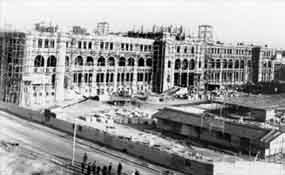
Collège Saint Marc
1927
My school , i miss it , looking to it let
me remember a lot of things and
passages ,M.E.J promesse, chorale de
(St Jean-Baptiste, concert, Noel ).....etc

2000

My Local server Up again:
Solution http://mina.homelinux.net
-Port 80 forwarding from my Speedtouch router NAPT configs.
-Register a host name with DynDNS .
-Assign it to Apache httpd config .
-Manipulate the htdocs directory.
-Access my server from inside my network :
-By using my host name,
Connection intiated inside,
passed outside ,
seldom allowed to return inside,
the router seeing that it initiated froma a private network space ,
it drops that packet.
-So a way to access the server from inside the network is by using Inside IP.
-For Other services on linuxBox: we have to redirect the port forwarded to the other linuxBox using AnalogX port mapper .
-Port 80 forwarding from my Speedtouch router NAPT configs.
-Register a host name with DynDNS .
-Assign it to Apache httpd config .
-Manipulate the htdocs directory.
-Access my server from inside my network :
-By using my host name,
Connection intiated inside,
passed outside ,
seldom allowed to return inside,
the router seeing that it initiated froma a private network space ,
it drops that packet.
-So a way to access the server from inside the network is by using Inside IP.
-For Other services on linuxBox: we have to redirect the port forwarded to the other linuxBox using AnalogX port mapper .
Subscribe to:
Posts (Atom)